Winter mud changes the arithmetic of a walk. A circuit that takes ninety minutes in June can swallow three hours in January, and a path you could follow at a glance in summer simply vanishes under standing water, churned grass and bootprints pointing in four directions. That is not a reason to stay home. It is a reason to change a few habits — most of them small, and most of them learned the hard way.
Trusting a Muddy Path to Still Be There
Mud erases evidence. Where a trail crosses open ground, the trodden line smears into a braided mess, and the widest, wettest channel is often not the right way — it is just the way most people have already gone. Follow it and you can end up on a farm track, a drainage ditch or a dead end.
Treat junctions as decision points rather than scenery. Stop, check the map, and confirm which direction you are leaving in before you move. Short compass bearings are worth the ten seconds they take, especially on open moorland where one tussock looks much like another. Line yourself up with a handrail — a wall, a stream, a fence line — and follow that rather than the mud. Note the feature you are heading for while you can still see it clearly. Download an offline map too: phone signals vanish in exactly the places paths do, and cold batteries drain faster than you expect.
Letting Feet Get Wet, Then Stay Wet
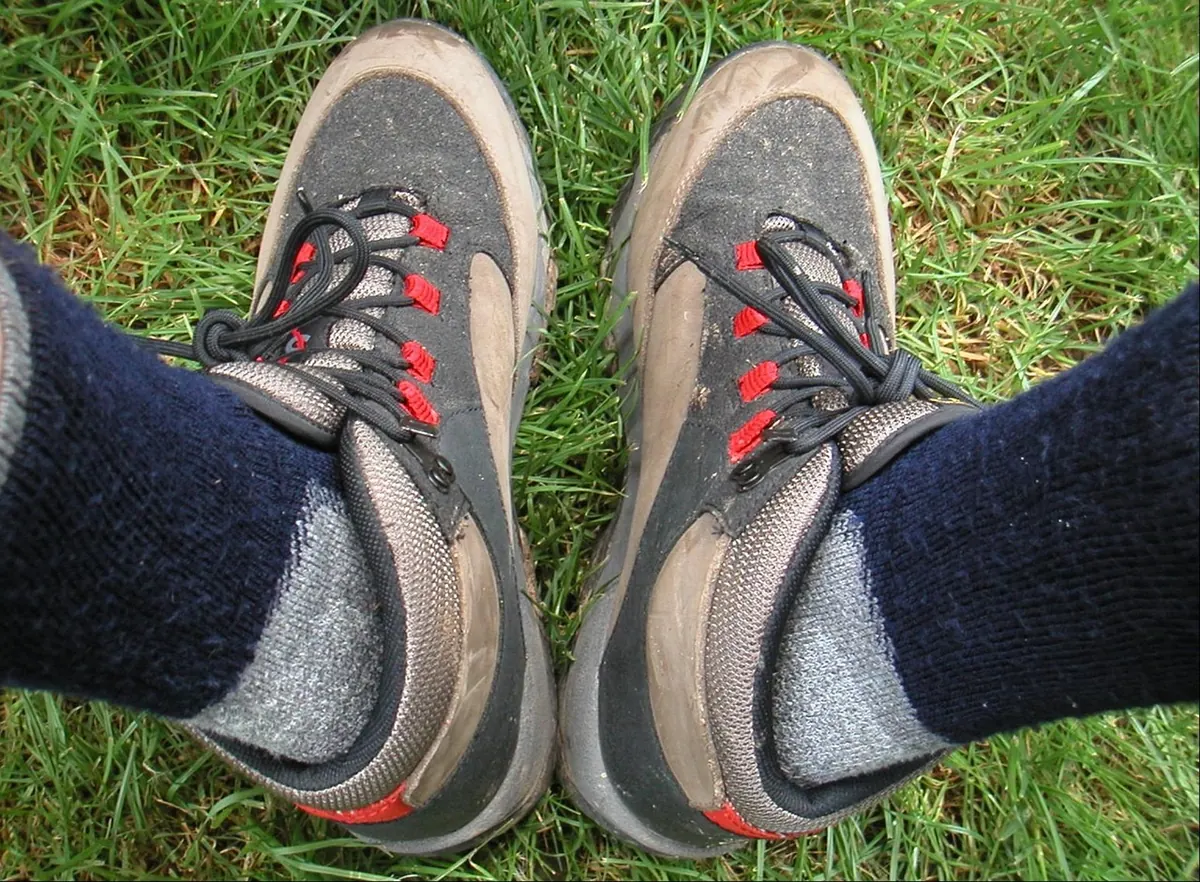
Wet feet are cold feet, and cold wet feet blister. The same mistakes turn up again and again: thin cotton socks, boots that stopped being waterproof last winter, no gaiters on tussocky ground, and no dry spare in the pack.
- Wear wool or synthetic socks, never cotton, and carry a second pair sealed in a dry bag.
- Gaiters keep the worst of the splash out and stop wet hems wicking water up your legs.
- Reproof boots before winter and rinse the mud off afterwards — dried mud cracks leather and clogs membranes.
- Tape hot spots the moment you feel rubbing, not after the blister has formed.
- Change socks at lunch if your feet are soaked. Two minutes of cold air beats four hours of damp.
- Dry boots slowly, away from radiators, stuffed with newspaper if they are sodden.
If toes go numb, waxy or white and do not recover once they are warm and dry, stop and seek proper medical help rather than walking it off.
Layering for Dry Cold, Then Standing Still
The common error is dressing for the temperature shown on the car dashboard and forgetting that you will sweat on the climb and then stop at a gate. Start slightly cool. Vent hard on ascents — open zips, push sleeves up, take the hat off — before you are damp through, because wet from the inside is every bit as cold as wet from the outside. Put the shell on before you stop, not after you have started shivering. Carry a dry mid layer in a dry bag; it weighs almost nothing and turns a miserable lunch stop into a tolerable one. Keep gloves and a spare hat somewhere you can reach without taking your pack off, and leave cotton next to your skin at home.
Stepping Around Every Puddle
One walker goes round the mud, then ten, then a hundred, and a single-track path becomes a four-metre scar of churned grass with the verge stripped bare. On busy routes this is genuine damage, and it takes years to heal. Where it is safe, walk through the mud rather than around the edge of it. Poles help with balance on the slippery bits. On waymarked or protected routes, follow the marked line even when it is unpleasant, and never cut a switchback — the short cut is always steeper, muddier and more eroded than the path you skipped.
Treating a Working Landscape as a Free-for-All
Most of a winter walk crosses somebody's livelihood. Leave gates as you find them — open if open, closed if closed — unless a sign says otherwise, and check that everyone in your group is through before you latch it. Use the stile or gate rather than climbing a wall or fence. Keep to the path across sown fields and walk the headland around crops rather than the crop itself. Give livestock plenty of room, particularly ewes and cattle, and keep dogs close and on a lead wherever signs ask for it.
Park so you are not blocking a gateway, a passing place or a field entrance, and park on hard standing: a churned-up verge in January is a complaint waiting to happen. Take everything home with you, including the apple core you were told would biodegrade. If someone challenges you, be polite and move on — nearly every conflict on a winter footpath comes down to a gate left open or a dog off the lead. Access rules differ between countries and often between neighbouring estates, so check the local guidance rather than assuming.
Planning the Route You Walked in Summer
Mud halves your speed on the flat and does worse on a slope. A twenty-kilometre summer day can become an eight-hour slog with the light going. When the ground is soaked, plan shorter, lower and closer to home, and set a turnaround time rather than a turnaround point — the point always looks nearer than it is. Check sunset, then add a buffer for the fact that everything takes longer in the dark. Carry a headtorch on every winter walk, even a two-hour one. Tell someone where you are going and when you expect to be back.
Before You Leave the House
- Check the forecast, and assume the trail will be wetter than the forecast suggests.
- Pick a lower route if the week has been wet — hills hold water long after the rain stops.
- Download the route offline and note the junctions where you could go wrong.
- Pack dry socks, a spare warm layer, a headtorch, water, food and a basic first aid kit.
- Wear boots with real tread and take poles if you have them.
- Set a turnaround time and stick to it.
- Park on hard standing and leave every gate exactly as you found it.
None of this is complicated and none of it takes long. Mud is not a sign you picked the wrong day; it is just the surface you happen to be walking on. A little preparation means you notice it less — and enjoy the quiet, empty, dripping countryside a great deal more.Photo: erge / Pixabay